A Summer in the Shadow of Silvia
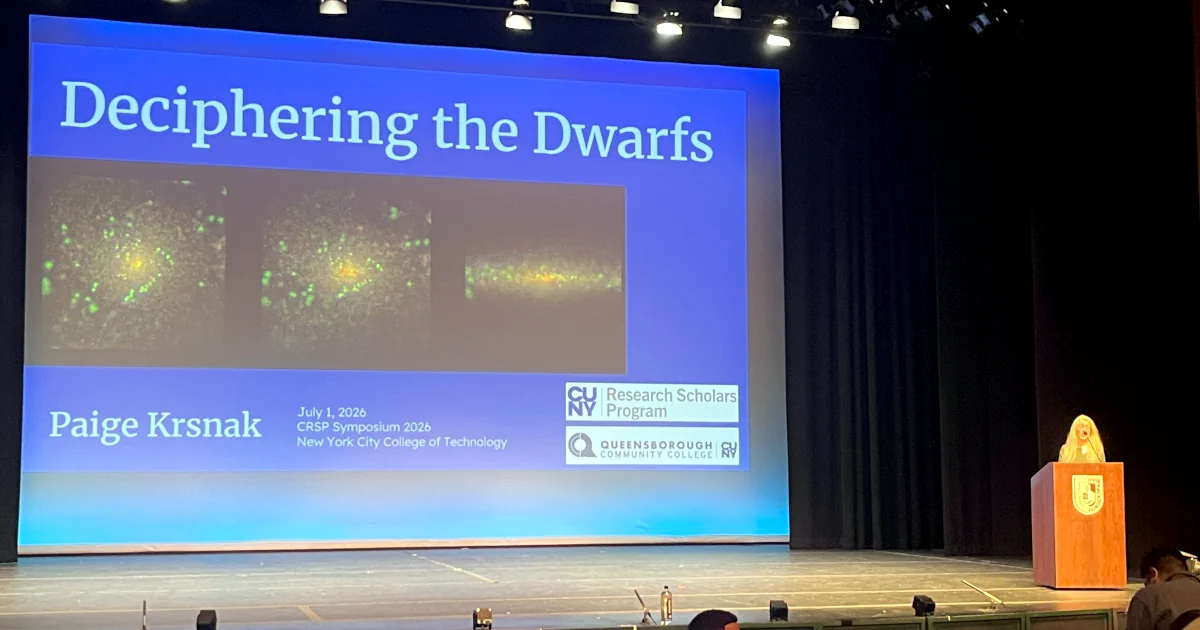
Most students at two-year colleges never get the opportunity to participate in research. The CUNY Research Scholars Program exists to close that gap, and it is the largest program of its kind in the country. Each CUNY community college runs its own cohort during the academic year, but the real highlight is the all-CUNY symposium held at the New York City College of Technology in July, where students and their mentors present posters on a year’s worth of work. Each college also chooses one student from its cohort to give a talk, and I was honored to be selected to represent Queensborough Community College for 2025–26.
My talk, “Deciphering the Dwarfs,” was about a question that turned out to run through my whole year: how can we apply simulation data to tell us more about real galaxies? Getting there was a stretch. Through the spring term, alongside my coursework, I was learning the fundamentals of particle-based cosmological simulations and how to read their snapshots in Python. I used the SKIRT radiative transfer code to turn those snapshots into synthetic observations — full-spectrum photometry, and images that imitate what a real telescope would see — and then compared my results against a collection of roughly 200 nearby galaxies, looking for clues as to whether massive black holes leave a measurable fingerprint in a galaxy’s color. The comparison was complicated by the fact that the real galaxies were, on the whole, smaller and bluer than my simulated ones. I also had to make corrections to this catalog of real galaxies to compensate for attenuation through the disk of the Milky Way, and this was a guess at best. We also don’t know for sure whether any of these real galaxies do or do not host massive black holes. But I came away with a methodology I want to extend to many more snapshots from ROMULUS.
Particles and Propagation
Astronomers have a particular penchant for naming things, an indispensable skill in a field where new objects are discovered every time we turn our detectors to the sky or create a new simulated universe in a supercomputer. Those who follow Star Trek might recognize Romulus as the homeworld of the Vulcans’ wayward twins; students of the classics might recognize one half of the legendary twin founders of the city of Rome, though they might also be reminded of the unfortunate fate of his brother. But few would know the name of the twins’ mother, Silvia, the vestal virgin from whom the twins were whisked away and later raised by a she-wolf who must herself have had a prodigious wealth of patience to care for two human children.
My summer was busy, to say the least. My talk at the CRSP finale was just one aspect I was juggling. I learned about the best ways to navigate around Queens and Nassau County as I kept up with the array of camps I’d enrolled my children in, hoping to kindle or create a new area of interest. I learned about the best places to park my car and where and when I could catch a LIRR route that didn’t require me to switch at Jamaica. And my summer project with AstroCom NYC was heating up; most days of the week I went into AMNH to collaborate with my research team. Our projects were pulling us in different directions, but they all intersected through the expertise of our mentor, Jillian Bellovary, and getting to work face-to-face was one of the best parts of the summer.
Like CRSP, AstroCom NYC closes its summer with a symposium. At the end of July, AstroCom NYC students present alongside the AMNH Summer REU students in astronomy and in earth and planetary sciences, and I gave my second talk of the summer there: “Twin Studies for Simulated Galaxies.”
Reining in the Twins
We still have a lot of open questions about how massive black holes work and how to model them. A simulation lets you write down a set of physical rules and see what happens when a system evolves under them, and that is exactly what my mentor and her collaborators did with a set of zoom-in galaxies from ROMULUS. For each zoom-in, they wrote their own model for how the black holes accrete gas and how much energy they return to the surrounding interstellar medium as feedback, then ran the galaxies forward to the present day.
My question was how the end states of these galaxies differed from one another, and whether each physical model left the same mark on galaxies that had started out different. So I set up a twin study: pairs of simulation runs that shared every parameter except one, so that any difference between the twins could be traced to a single change in the physics.
The first pair compared a galaxy with a massive black hole to the same galaxy without one, and this was tricky, because what I got was essentially a null result. The color difference wasn’t large enough to separate from run-to-run noise. Every simulation run is unique — you never get the same galaxy twice, even with identical inputs — so a difference between two runs only means something if it’s bigger than that intrinsic scatter, and mine wasn’t.
The second pair compared two different feedback models. The first thing I noticed was that when a smaller fraction of the accreted material was returned to the environment as energy, the black holes ended up more massive. I still have questions about why, but it likely comes down to feedback heating and pushing away the very gas the black hole feeds on. Changing the feedback model left a much more visible mark on the galaxies than adding or removing the black hole had: the synthetic images were more varied and more interesting, and in one case the galaxy was fully quenched.
I finished the summer with more questions than I started with. I didn’t get to the question of where the black holes sit within their hosts — a centrally located black hole will almost certainly shape its galaxy differently than one drifting near the edge. And I restricted my analysis to the single most massive black hole in each galaxy, when the real picture involves an entire population of them. The picture is much more complicated than I had supposed, which I’ve come to understand is the normal condition of doing this work.
Orbital Shift
I’ll keep chasing these questions through the academic year. I’ve just transferred to Queens College and am starting the physics program there, and my summer pushed me to add a minor in mathematics. When I was analyzing my data, I could see a real gap in what I knew: I understood that run-to-run noise mattered and that I had to quantify it, but how, and at what point can I say a signal has emerged from the noise? Astronomers have always had more data than we can analyze in a lifetime, and simulations add to that pile at a startling rate. If I want to make sense of what the numbers and trends are telling us, I need to understand statistics as a tool rather than an obstacle. That’s the next thing.